

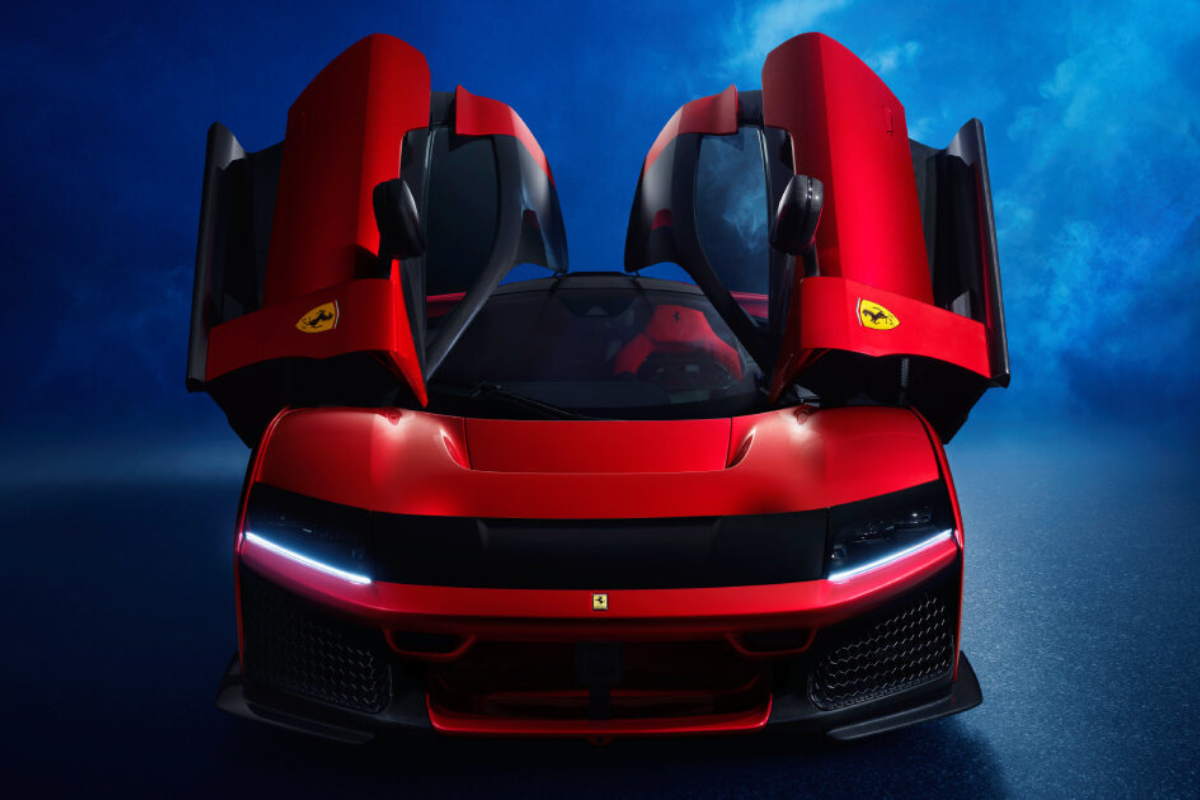
The Ferrari F80 is not just another concept car. It represents a bold vision of what hypercars might become in the next decade. Designed by Adriano Raeli, the F80 pushes the boundaries of automotive design and performance while remaining a concept that feels astonishingly close to reality. From its aggressive aerodynamics to its futuristic hybrid powertrain, the Ferrari F80 is an ambitious glimpse into the future of high-performance driving.
In this blog, we’ll explore the radical design, mind-bending performance numbers, and visionary technology that make the F80 more than just a dream—it’s a challenge for the future of hypercars.
Radical Aerodynamics Inspired by Fighter Jets
The F80 doesn’t adhere to the conventional rules of supercar design. Its sharp, angular bodywork draws inspiration from stealth fighter jets, featuring sculpted airflow channels, razor-sharp edges, and a low-slung stance that hugs the asphalt.
The focus here is pure performance: every curve, vent, and surface is designed to optimize speed, downforce, and aerodynamics. Unlike traditional road cars that compromise aerodynamics for comfort or practicality, the F80 is unapologetically aggressive. This approach results in a car that looks ready to take flight even when parked.
Key design highlights:
- Stealth-inspired body panels with sharp edges
- Sculpted air channels to reduce drag and enhance stability
- Extreme ground-hugging stance for maximum downforce
- Lightweight carbon-fiber construction for optimal aerodynamics
The Ferrari F80 proves that the hypercar of the future will not only be fast—it will also be a sculptural masterpiece in motion.
Hybrid Power That Outpaces Imagination
One of the most exciting features of the Ferrari F80 concept is its innovative hybrid powertrain. Moving away from Ferrari’s traditional V12 engines, the F80 pairs a twin-turbo V8 with a KERS-style hybrid system, creating a total output of approximately 1,200 horsepower.
This combination of combustion and electric assistance is not just about sheer speed—it represents a new philosophy: balancing power, efficiency, and sustainability. The hybrid system allows instantaneous torque delivery, enhancing acceleration while improving energy efficiency.
Why this matters:
- Twin-turbo V8 engine for ultimate combustion performance
- KERS-inspired hybrid system for instant torque and energy recovery
- Total output: ~1,200 horsepower
- Balances raw power with hybrid efficiency
The F80’s powertrain hints at a future where hypercars can remain environmentally conscious without sacrificing thrill or performance.
Mind-Bending Speed Numbers
If the Ferrari F80 were ever to hit the production line, its projected performance numbers are staggering:
- Top speed: 310 mph
- 0-60 mph acceleration: 2.2 seconds
These figures surpass the capabilities of nearly every hypercar currently on the market. Even if the F80 remains a concept, it sets a benchmark for engineers and designers to explore beyond traditional limitations.
Such extreme performance also challenges our perceptions of what hypercars can achieve. It forces the automotive world to imagine new solutions in aerodynamics, tire technology, and chassis engineering.
Lightweight Design for Maximum Efficiency
A critical aspect of the Ferrari F80 is its emphasis on weight reduction. Built around a carbon-fiber monocoque chassis and lightweight materials, the concept car’s estimated weight is just 1,800 pounds.
This lightweight philosophy not only improves acceleration and top speed but also enhances handling, braking, and overall efficiency. In hypercar design, shedding weight is as important as adding horsepower—it’s the combination that allows for unmatched agility and performance.
Highlights of lightweight design:
- Carbon-fiber monocoque chassis for rigidity and lightness
- Ultra-lightweight panels and components
- Reduced weight improves acceleration, braking, and handling
The F80 shows that the next generation of hypercars will likely prioritize materials innovation as much as engine technology.
A Glimpse Into Ferrari’s Possible Design Direction
While the F80 is not an official Ferrari model, it provides a hint at the brand’s potential future direction. Ferrari has already begun embracing hybrid technology with cars like the SF90 Stradale, but the F80 imagines a more radical future—faster, cleaner, and more aerodynamic.
This concept allows designers and fans alike to envision a Ferrari unbounded by traditional limits. Its futuristic styling, hybrid powertrain, and aggressive aerodynamics suggest that Ferrari’s future hypercars could be revolutionary.
Key points:
- Hybrid performance could become standard for hypercars
- Radical aerodynamic approaches may redefine Ferrari’s styling
- A focus on lightweight construction could influence upcoming models
Reimagining the Driving Experience
Inside the F80, the driving experience is designed to be a fusion of Formula 1 technology and fighter jet ergonomics. The cockpit is minimalist, with advanced digital displays and immersive controls that make the car feel like an extension of the driver.
This approach isn’t about luxury—it’s about connection, speed, and ultimate control. Every element in the cabin is crafted to enhance focus and performance, from the seating position to the interface with the car’s hybrid systems.
Cockpit highlights:
- Formula 1-inspired driver interface
- Digital displays for real-time performance data
- Minimalist interior for maximum concentration
- Ergonomics designed for precision and control
The F80 demonstrates that the future of hypercar interiors may prioritize experience and functionality over lavish appointments.
Performance and Sustainability Can Coexist
The F80 makes a powerful statement: speed and sustainability are no longer mutually exclusive. Its hybrid powertrain, lightweight materials, and aerodynamic efficiency indicate a future where high-performance cars can also be environmentally conscious.
This concept challenges the industry’s traditional mindset, proving that hypercars can evolve without compromising their essence.
Takeaways:
- Hybrid power enables responsible high-speed driving
- Lightweight materials reduce energy consumption
- Aerodynamic efficiency improves performance and reduces environmental impact
The F80 sets an example for a smarter, more sustainable kind of performance that the automotive world is beginning to embrace.
The F80 Isn’t Just a Dream—it’s a Challenge
Even though the Ferrari F80 exists only as a concept, its impact is very real. It challenges automakers to think differently, break molds, and push technological boundaries. Designers are encouraged to take risks, engineers to solve unprecedented problems, and enthusiasts to reimagine what hypercars could be.
This concept is more than just a sketch—it’s a symbol of ambition, innovation, and the limitless possibilities of automotive engineering.
Final Thoughts
The Ferrari F80 may never reach production, but its influence is undeniable. It embodies the spirit of next-generation hypercars through radical design, smarter power, and mind-blowing performance. Whether it remains a concept or inspires the next Ferrari lineup, the F80 reveals a vision of the future: faster, cleaner, and more extraordinary than ever before.
The Ferrari F80 is not merely a concept—it is a challenge, a dream, and a glimpse of the future of hypercars in motion.
FAQ
Q1: Is the Ferrari F80 a production car?
A: No, the Ferrari F80 is a concept car designed by Adriano Raeli. It is not an official Ferrari production model.
Q2: What makes the F80 different from current Ferrari hypercars?
A: The F80 features a futuristic hybrid powertrain, extreme aerodynamics inspired by fighter jets, and a lightweight construction that pushes the boundaries of performance.
Q3: How fast can the Ferrari F80 go?
A: The concept is projected to reach a top speed of 310 mph and accelerate from 0-60 mph in 2.2 seconds.
Q4: Will Ferrari make a car like the F80?
A: While the F80 is purely a concept, it provides insight into Ferrari’s potential design and technological direction for future hypercars.
Q5: Does the F80 focus on sustainability?
A: Yes, through its hybrid powertrain and lightweight construction, the F80 demonstrates that high performance and sustainability can coexist.
